
Owning property with another person can be a powerful investment strategy, but it can also become a serious source of conflict when expectations and conduct diverge. Disagreements over how the property is used, who pays which expenses, or how income is handled often escalate beyond mere frustration. In many cases, one co-owner’s decisions begin to materially harm the property itself and quietly drain the equity the other owner reasonably expects to share.
For example, a co-owner may collect rent but refuse to share the proceeds, stop paying the mortgage or property taxes, or allow the property to fall into disrepair while continuing to live there rent-free. Left unchecked, this kind of conduct can reduce market value, increase debt, and leave the responsible co-owner holding the financial consequences. California law recognizes this risk and provides legal tools that allow a co-owner to intervene early, before mismanagement or neglect causes permanent and irreparable damage to the shared investment.
The Line Between Normal Use and Property Waste
In property law, waste describes behavior by a person in possession of real property that causes meaningful damage to the property or diminishes its value. It encompasses both harmful actions and harmful inaction, meaning waste can occur not only through what a person does, but also through what they fail to do. See Schellinger Bros. v. Cotter, (2016) 2 Cal. App. 5th 984, 1000.
At its core, the doctrine of waste exists to protect the legitimate interests and reasonable expectations of other owners who share rights in the same property, ensuring that one party’s use or neglect does not unfairly impair the value of the shared estate. Thus, waste is, functionally, a part of the law which keeps in balance the conflicting desires of persons having interests in the same land. See Cornelison v. Kornbluth, (1975) 15 Cal. 3d 590, 598.
In the context of co-owned real property, willful mismanagement refers to behavior that causes damage or loss to the property because a co-owner knowingly, or with reckless indifference, fails to maintain or responsibly manage it.
How Waste Can Quietly Drain Your Equity
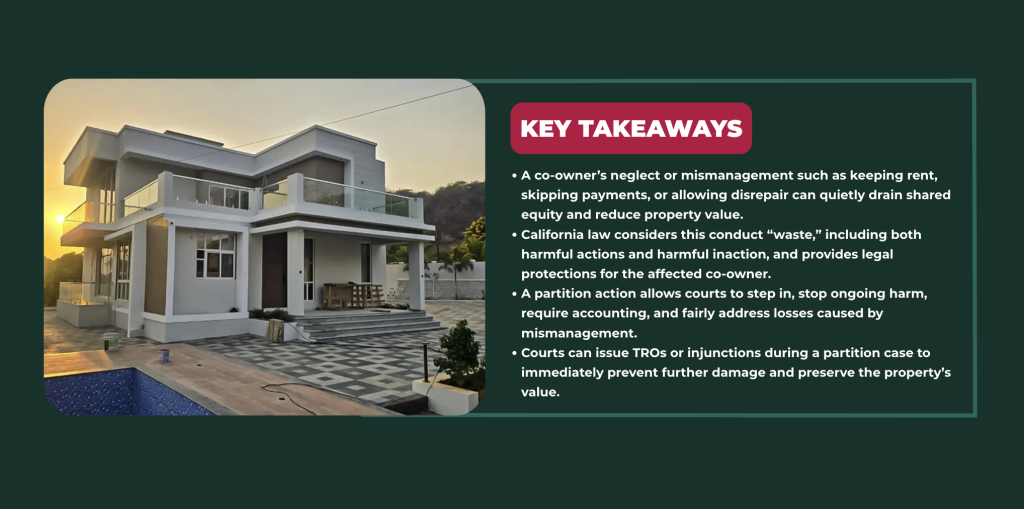
Waste and mismanagement are not just legal concepts. In real life, they show up as very practical and costly problems that can steadily eat away at a property’s value and, with it, each co-owner’s equity. When one co-owner neglects the property or manages it irresponsibly, the financial impact is rarely abstract. It is reflected in declining market value, rising expenses, and reduced sale proceeds.
For instance, allowing a property to fall into disrepair can depress its resale value and require significant repairs before it can be sold. Failing to pay property taxes or insurance can result in liens, penalties, or even forced sales, all of which directly reduce the equity available to divide later. Courts recognize that this kind of neglect can amount to waste when it causes a lasting reduction in the property’s market value. See Smith v. Cap Concrete, Inc. (1982) 133 Cal.App.3d 769.
Mismanagement can be just as damaging. A co-owner who collects rent but keeps the income for themselves, or who refuses to apply that income toward shared expenses, deprives the other owner of both cash flow and the ability to protect the property. Over time, this imbalance compounds. California courts have long held that willful mismanagement or the failure to take basic steps necessary to preserve property can constitute bad faith waste. See Robinson v. Russell (1864) 24 Cal. 467, 473.
In short, waste and mismanagement do not just strain relationships between co-owners. They threaten the property itself and can quietly drain the very equity that made the investment worthwhile in the first place.
When Co-Owners Can’t Agree: How Partition Comes Into Play
These problems often come to a turning point in a partition case. A partition action is the legal solution used when co-owners can no longer agree on how a property should be used or what should happen to it. When one co-owner neglects the property, misuses rental income, or makes decisions that reduce value, the relationship between co-owners quickly breaks down. At that point, partition becomes more than a way to end shared ownership, it becomes a tool to stop ongoing harm and protect what remains of the property’s value. Under California law, any co-owner generally has an ‘absolute right’ to seek partition, unless that right has been validly waived.
Once a partition case is filed, the court does not simply order a sale and walk away. It has the power to step in and address waste, require financial accounting, and ensure that one co-owner does not continue draining equity while the case is pending. In this way, partition serves both as an exit from an unworkable ownership arrangement and as a safeguard against further mismanagement, giving the court authority to preserve the property and fairly allocate responsibility for damage or loss when the property is ultimately divided or sold.
Stopping the Damage Before It’s Too Late: Injunctive Relief in Partition Cases
When a co-owner’s behavior poses an immediate risk to the property, for instance, renting it out without consent, removing fixtures, or allowing serious neglect, waiting until the lawsuit is over can result in real and lasting damage. By the time the case ends, the property’s value may already be significantly reduced. Recognizing this risk, California law allows courts to step in early to protect the property and preserve its value.
One of the primary tools courts use is injunctive relief, including a temporary restraining order (TRO) or a preliminary injunction. These court orders are designed to stop harmful conduct while a partition case is still pending, before the damage becomes irreversible. California Code of Civil Procedure § 872.130 specifically authorizes courts to issue TROs and injunctions during a partition action for the purpose of preventing waste, protecting the property or its title, and stopping unlawful interference with the court’s authority over the property.
This means the court does not have to wait for the final outcome of the case to act. It can intervene early to halt damaging behavior, maintain the status quo, and prevent one co-owner from continuing to drain equity or harm the property while the legal process moves forward. However, whether to issue a TRO is ultimately up to the court and depends on a showing that serious harm is likely if the order is not granted. Courts have made clear that the purpose of a TRO is not to decide the case, but to preserve the status quo and protect the property from damage while the underlying legal dispute is being worked out.
What to Do If a Co-Owner Is Wasting or Mismanaging the Property
If you believe a co-owner is draining equity or harming the property:
- Document everything. Gather and preserve bills, photographs of the property’s condition, rental records, and written communications that reflect neglect, misuse, or financial impropriety.
- Consult an experienced real estate attorney. An attorney familiar with partition actions can assess whether to seek immediate injunctive relief, file a partition action with an accounting, or pursue both options together.
- Act promptly. Courts consider urgency and the risk of irreparable harm when issuing injunctions. Delays can undermine your ability to obtain meaningful protection.
Preserving the Property and Your Rights
Co-ownership can unravel fast when one party acts without regard for shared interests. California law empowers you to stop waste, mismanagement, or self-dealing before your equity vanishes. Through timely action and proper use of equitable remedies such as injunctions or receivership, you can protect both the property’s value and your rightful share of it.
If you believe your co-owner is mismanaging the property or threatening your investment, seek legal guidance immediately as the courts have tools to restore balance and ensure that the property you worked hard to build retains the value you deserve.